PLA print settings and tips
The filament most prints start with: it prints at modest temperatures, barely warps, needs no enclosure and comes in more colours and finishes than any other.
At a glance
- Nozzle
- 220 °C
- Range to test
- 190–240 °C
- Bed
- 55–60 °C
- Density
- 1.24 g/cm³
- 1 kg of 1.75 mm
- ≈ 335 m
- 1 kg of 2.85 mm
- ≈ 126 m
In each slicer's profile
| Slicer | Nozzle | First layer | Bed | Fan | Max flow |
|---|---|---|---|---|---|
| Bambu Studio Bambu PLA Basic @BBL P1S 0.4 nozzle | 220 °C | 220 °C | 55 °C | 100–100% | 21 mm³/s |
| OrcaSlicer Generic PLA @Creality | 220 °C | 220 °C | 55 °C | 100–100% | 12 mm³/s |
| PrusaSlicer Generic PLA @MK4S | 220 °C | 230 °C | 60 °C | 70–100% | 15 mm³/s |
As each slicer ships its profile for a 0.4 mm nozzle (Bambu Studio for the P1S, OrcaSlicer for the Creality K1, PrusaSlicer for the MK4S). The profile named after a brand is that brand's own filament.
Good for
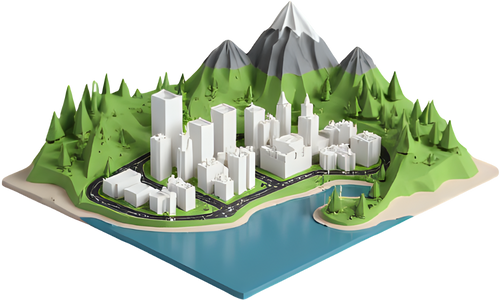
- Terrain models, city models and map gifts
- Lithophanes, in white or natural
- Ornaments, keychains, signs and name tags
- Prototypes and anything kept indoors
Not the best for
- Anything left in a hot car or in strong sun: PLA softens at quite low temperatures
- Parts that must bend without breaking
Printing it well
- Keep the part cooling fan on: PLA likes plenty of cooling.
- A clean plate is usually all it needs to stick; wash it with dish soap and water if prints start to lift.
- For terrain and lithophanes, a temperature tower shows the cleanest temperature for each brand.
Tune it for your printer
Temperature tower · Retraction test · Flow rate test · What a print costs
Questions
What temperature should I print PLA at?
The slicers' own profiles print it at 220 °C on the nozzle, within a range of 190 to 240 °C. Print a temperature tower to find the best value for your brand.
What bed temperature does PLA need?
The slicer profiles heat the bed to 55–60 °C.
How many metres are on a 1 kg spool of PLA?
About 335 m of 1.75 mm filament, or 126 m of 2.85 mm, at a density of 1.24 g/cm³.
Is PLA good for 3D printed terrain models?
Yes. It holds fine detail, barely warps on large flat bases and comes in the colours terrain needs: greens, browns, greys, white for snow and blue for water.
Does PLA need a heated bed?
It prints best on a warm one. The slicer profiles warm the bed to about 55 to 60 °C on a textured or smooth PEI plate.
Is PLA food safe?
Not reliably: colours and additives vary, and layer lines can hold bacteria. Use printed parts as moulds for food-safe silicone, or keep contact with food brief.
Other filaments
Settings from each slicer's own filament profile, checked 2026-11-15.