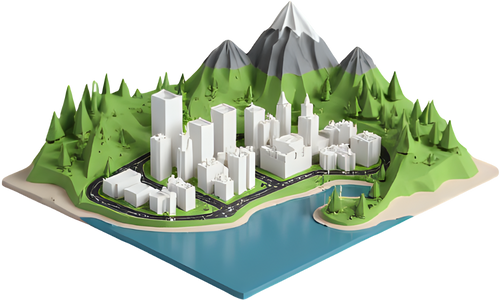
The answer key prints on its own page, so you can keep it back. Prints in black and white on A4 or Letter.
TerraPrinter Classroom · Worksheet · Ages 10–15
Coastal erosion: cliffs, arches and stacks
Name Class Date
Waves crash against the coast every day. Over time they wear away the rock and the coastline moves back. Use the models of the Cliffs of Moher in Ireland and the Twelve Apostles in Australia.
Open a link in a web browser to see the model in 3D, or use the printed model from your teacher.
The Cliffs of Moher model is 150 mm across for 4 km at true scale, so 1 mm is about 27 m. Measure the height of the highest cliff on the print. How high is it in real life?
Which way do the Cliffs of Moher face? Where do the biggest waves come from?
Draw the steps a headland goes through as the sea wears it away. Label: crack, cave, arch, stack, stump.
On the Twelve Apostles model, look just off the cliffs for rocks standing in the sea. What are they called, and how did they form?
Waves wear back the bottom of the Twelve Apostles cliffs by about 2 cm a year. How far is that in 100 years? In 1,000 years?
Waves cut a notch at the bottom of a cliff. What happens to the rock above the notch? What is left at the foot of the cliff?
Hard rock makes headlands that stick out. Soft rock makes bays. Explain why.
A town on an eroding clifftop wants to protect its houses. Give one way to do it, and one reason it might not be worth it.
TerraPrinter Classroom, CC BY 4.0: free to copy and adapt with credit.
TerraPrinter Classroom · For the teacher
Answer key: Coastal erosion: cliffs, arches and stacks
Learning goals
Explain how waves wear away cliffs and make them retreat.
Describe how a headland becomes a cave, an arch, a stack and a stump.
Explain why hard rock makes headlands and soft rock makes bays.
Answers
The Cliffs of Moher model is 150 mm across for 4 km at true scale, so 1 mm is about 27 m. Measure the height of the highest cliff on the print. How high is it in real life?About 8 mm on the print, which is about 210 m. The highest point of the cliffs is 214 m.
Which way do the Cliffs of Moher face? Where do the biggest waves come from?West, out over the open Atlantic Ocean. Storm waves build up over thousands of kilometres of ocean before they hit the cliffs.
Draw the steps a headland goes through as the sea wears it away. Label: crack, cave, arch, stack, stump.Waves widen a crack into a cave. The cave cuts right through the headland to make an arch. The roof of the arch falls in, leaving a stack standing alone. The stack is worn down into a low stump.
On the Twelve Apostles model, look just off the cliffs for rocks standing in the sea. What are they called, and how did they form?Sea stacks. They were once part of the cliffs. Waves cut caves and arches into the headlands, and when the arches fell in, pillars of rock were left standing in the sea.
Waves wear back the bottom of the Twelve Apostles cliffs by about 2 cm a year. How far is that in 100 years? In 1,000 years?100 years: 200 cm = 2 m. 1,000 years: 20 m.
Waves cut a notch at the bottom of a cliff. What happens to the rock above the notch? What is left at the foot of the cliff?The rock above hangs over with nothing to hold it up, so it breaks off and falls. The cliff moves back but stays steep, and a flat rocky shelf (a wave-cut platform) is left at its foot.
Hard rock makes headlands that stick out. Soft rock makes bays. Explain why.Soft rock wears away faster, so the coast is cut back into a bay. Hard rock resists the waves and is left sticking out as a headland.
A town on an eroding clifftop wants to protect its houses. Give one way to do it, and one reason it might not be worth it.Ways: a sea wall, big rocks piled at the foot of the cliff (rock armour), or barriers along the beach that hold sand in place (groynes). Reasons against: they are very expensive, need repairs, can make erosion worse further along the coast, and only slow it down.
Before the lesson
Print the models at 150 mm wide, 0.2 mm layers, 10–15% infill, no supports. Small areas at or near true scale, so the cliffs stand up sharply. Sea stacks are narrow; the bigger ones show as rocks standing off the cliff, but the smallest may be too thin for the elevation data. Measurements on the sheet assume the 150 mm size. Students' measured answers will vary a little with how they measure. Discussion questions and a hands-on activity for this topic: terraprinter.com/classroom/#coastal-erosion